


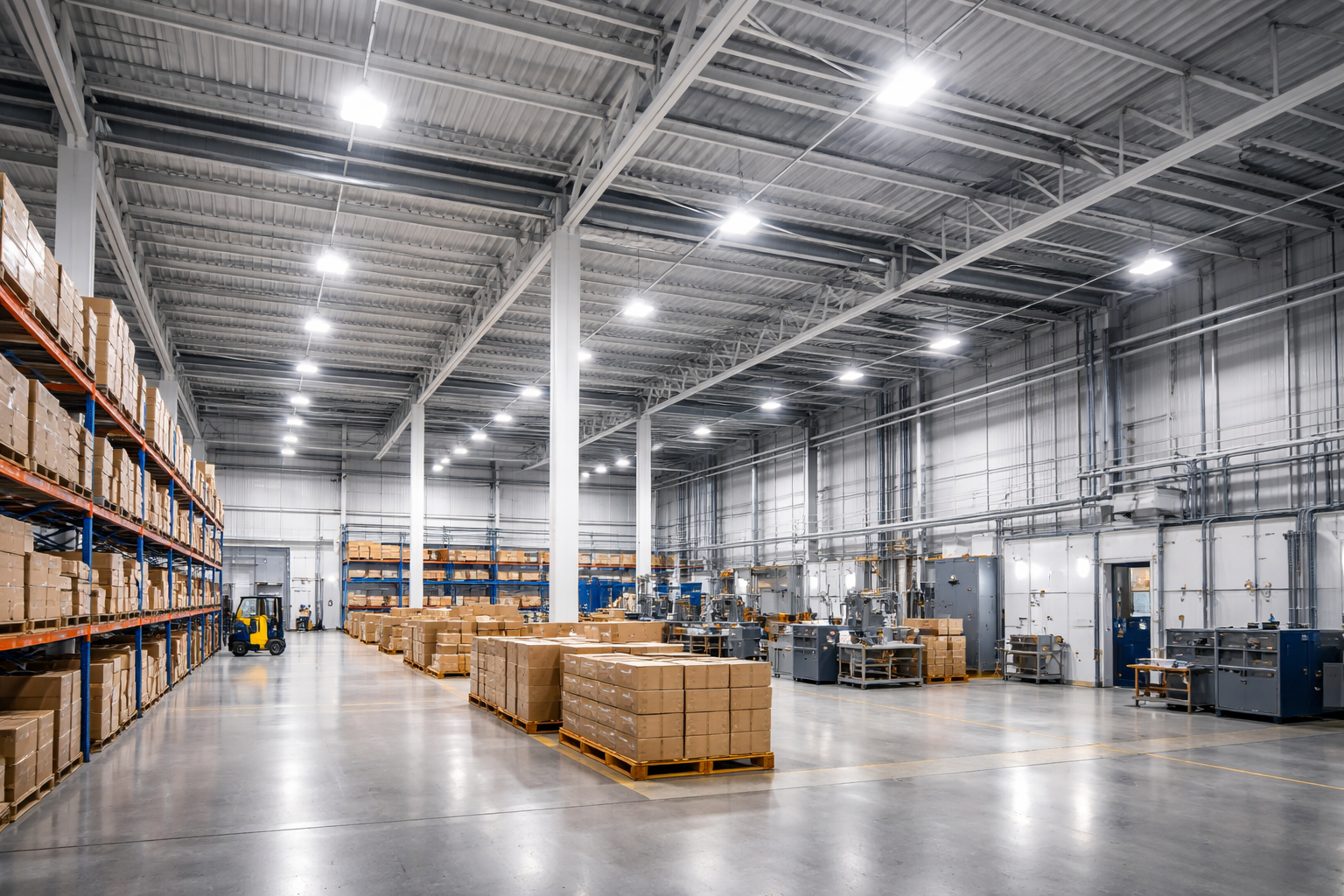
Industrial facilities often waste energy when lighting is set to full output in unoccupied or low-use areas. Large warehouses, manufacturing plants, and distribution centers typically run high-bay and overhead lighting continuously, or with basic, fixed dimming settings, even when activity is low.
This article discusses how networked lighting control systems improve lighting efficiency in industrial environments by adjusting fixture output based on advanced occupancy and operational needs. It explains why aligning lighting usage with real-world facility activity data helps reduce energy consumption while maintaining appropriate illumination levels.
Why Lighting Efficiency Matters in Industrial Facilities
Industrial facilities operate lighting across large floor areas. Warehouses, manufacturing plants, and distribution centers illuminate production, storage, loading docks, and circulation areas.
A typical high bay fixture rated around 200W can cost roughly $210 per year to operate continuously at a standard electricity rate of $0.12 per kWh. In a 500,000 square foot warehouse with approximately 1,500 fixtures, that can exceed $315,000 annually, with a significant portion potentially wasted when large areas remain unoccupied.
Energy costs increase when lighting runs regardless of occupancy or task requirements. High bay fixtures may illuminate empty aisles, and overhead lighting may remain at maximum levels in partially occupied areas.
Facilities reduce operating costs by aligning lighting usage with actual activity. When lighting matches real operational needs, unnecessary consumption is avoided while maintaining safe and effective illumination.
What Are Industrial Lighting Control Systems
Lighting control systems manage fixture output based on occupancy, scheduling, and daily operational patterns. A lighting control solution typically includes sensors, controllers, and centralized management tools that coordinate lighting behavior across different areas of a facility. The SiteWorx networked lighting control system provides this centralized coordination across the facility, allowing teams to manage lighting behavior from a single platform.
An occupancy sensor detects movement and directs controllers in fixtures to adjust lighting levels accordingly. Instead of a simple on/off operation, fixtures can dim to appropriate levels as activity decreases. SiteWorx sensors integrate occupancy and fixture control into a single device, reducing upfront installation costs.
Lighting control software provides a centralized view of system performance and allows facility teams to manage schedules and lighting behavior more easily. SiteWorx goes one step further, eliminating scheduling and instead applying conditional dimming settings based on aggregated occupancy data collected. This strategy, called Setback, drives higher energy savings and minimizes the time facility managers need to spend inputting shift schedules.
Key Technologies Behind Modern Lighting Control Systems
An occupancy sensor with a dimmer forms the foundation of many industrial lighting control strategies. When activity is detected, lighting operates at programmed levels. When spaces become vacant, fixtures automatically dim or switch off.
Lighting systems can integrate across departments or buildings to operate as a single, coordinated system. This allows organizations to manage lighting consistently across different areas. SiteWorx support this coordinated approach, ensuring lighting behavior remains consistent across departments, buildings, and facilities worldwide.
Lighting control software helps track electricity usage across the facility. It provides visibility into system status and usage patterns without requiring complex technical management.
Advanced occupancy based dimming like Setback adds another layer of control. Facilities can set baseline lighting levels that reflect target levels during operating hours, then rely on the lighting system to determine when it’s safe to dim and save energy.
How Lighting Control Systems Improve Industrial Efficiency
Lighting control systems reduce electrical consumption by ensuring lighting operates only when needed. An integrated occupancy sensor and controller automatically reduces fixture output in unoccupied spaces, eliminating unnecessary power consumption.
Fixtures can also partially dim during periods of partial occupancy. This flexible response helps maintain appropriate lighting while avoiding excessive consumption.
A lighting control solution supports better visibility into lighting performance. Within the SiteWorx platform, lighting data can be automatically reviewed alongside occupancy and operational trends.
Lower runtime also supports longer fixture lifespan, helping reduce maintenance demands over time.
Common Industrial Use Cases for Lighting Control Systems
Warehousing facilities use lighting control systems to manage illumination across storage aisles and circulation areas. Fixtures operate at full or trimmed brightness in active areas and dim or turn off in vacant areas.
Manufacturing plants apply lighting controls in production spaces and support areas. Lighting responds to shift schedules (automatically, with Setback) and varying activity levels throughout the day.
Distribution centers align lighting output with operational activity in sorting and loading areas.
Cold storage operations benefit from lighting that responds to occupancy while reducing additional heat output from fixtures running unnecessarily.
Transportation and maintenance facilities use a lighting control solution to manage illumination in spaces that are only intermittently occupied. Across these environments, SiteWorx lighting control solutions adapt to varying activity patterns while maintaining centralized oversight.
Conclusion
Industrial lighting control systems reduce energy costs by aligning fixture output with occupancy and operational requirements. An integrated occupancy sensor, combined with centralized software, helps eliminate unnecessary lighting consumption while maintaining appropriate illumination levels.
Facilities implement a reliable lighting control solution to improve efficiency, reduce operating expenses, and ensure lighting performance reflects actual facility activity.